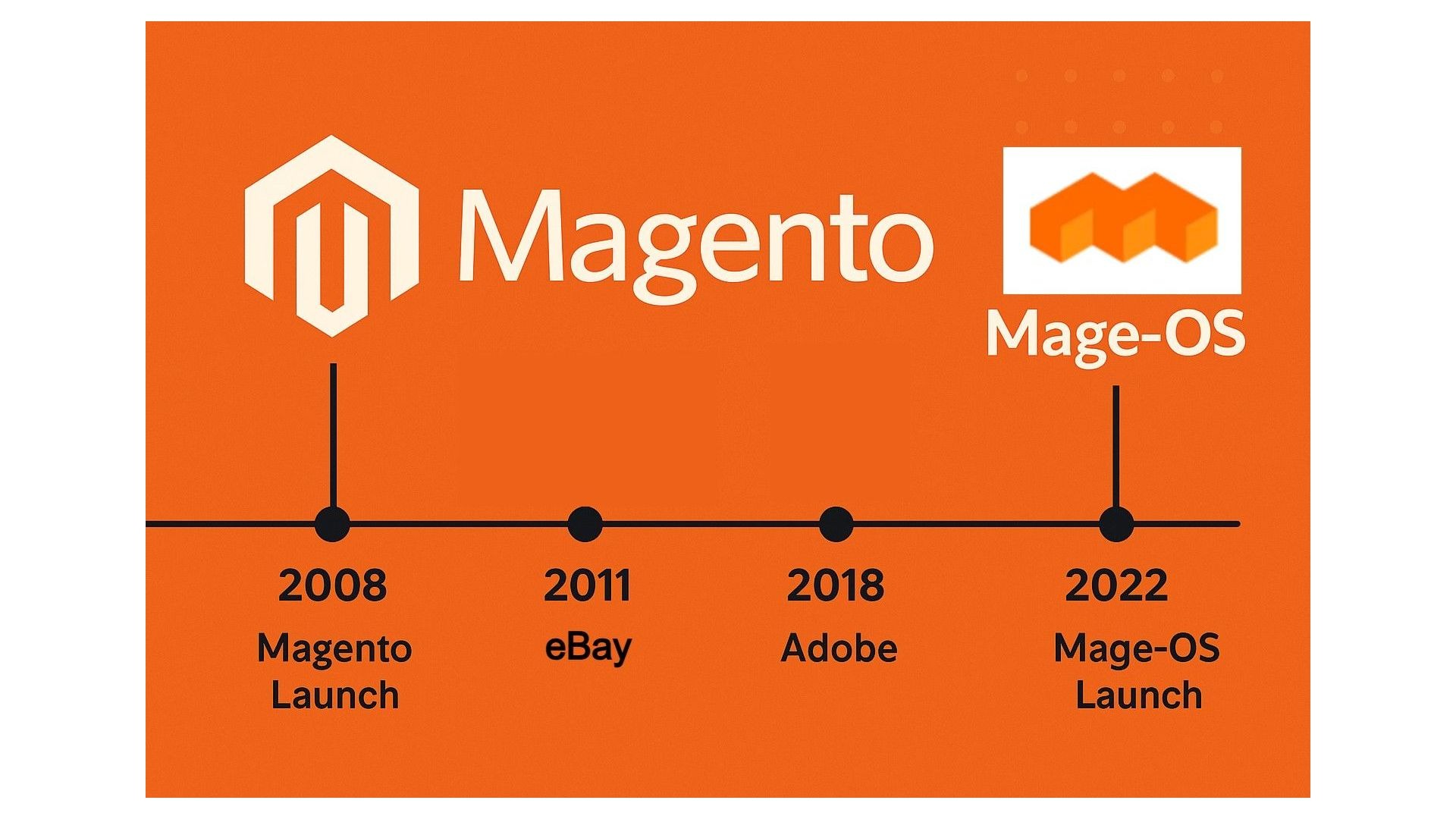
Magento was first released publicly on March 31, 2008, by Varien, a company founded by Roy Rubin. It quickly became popular for its flexibility, customization options, and powerful e-commerce capabilities.
Here's a brief timeline of Magento's history:
2007: Development of Magento started internally at Varien.
March 31, 2008: Magento Community Edition (now known as Magento Open Source) was publicly released.
2009: Magento Enterprise Edition (now Adobe Commerce) was introduced, providing additional features targeted at larger businesses.
2011: eBay acquired Magento.
2015: Magento became an independent company again after being spun off from eBay.
May 2018: Adobe acquired Magento for approximately $1.68 billion.
2021 onward: Adobe continues to develop Magento under the brand Adobe Commerce, alongside the open-source version.
As of 2025, Magento has been around for 17 years since its initial release.
Mage-OS
Mage-OS was announced in May 2022 as a community-driven initiative aiming to preserve and further develop the open-source Magento ecosystem independently from Adobe.
Background and Purpose:
Adobe's acquisition of Magento in 2018 led to concerns among developers and agencies regarding the future and openness of Magento's open-source edition. The Mage-OS initiative emerged as a response to these concerns, aiming to:
Maintain and enhance the open-source philosophy behind Magento.
Provide faster innovation cycles and more transparent governance.
Ensure that merchants and developers have a viable long-term alternative free from commercial vendor constraints.
Key Milestones:
May 2022: Official launch of Mage-OS initiative, initially as a fork of Magento Open Source.
2023 onward: Active growth of community support, roadmap development, and introduction of community-driven enhancements and innovations.
Core Goals of Mage-OS:
Community Ownership: A transparent governance model driven by community input.
Enhanced Innovation: Faster integration of new features and community contributions, quicker response to merchant and developer needs.
Backward Compatibility: Commitment to keeping compatibility with existing Magento 2.x extensions and themes to ease transition.
Vendor-Neutral Approach: Removing reliance on any single corporate entity.
Technical Evolution:
Mage-OS began as a direct fork of Magento Open Source 2.4.x.
Gradually evolved by adding community-driven enhancements, performance optimizations, and improvements focused on reducing complexity and improving developer experience.
Maintains compatibility with Magento's extension ecosystem and development standards.
As of 2025, Mage-OS is approximately 3 years old and continues to gain momentum within the Magento community.
Check out Mage-OS at: https://www.mage-os.org