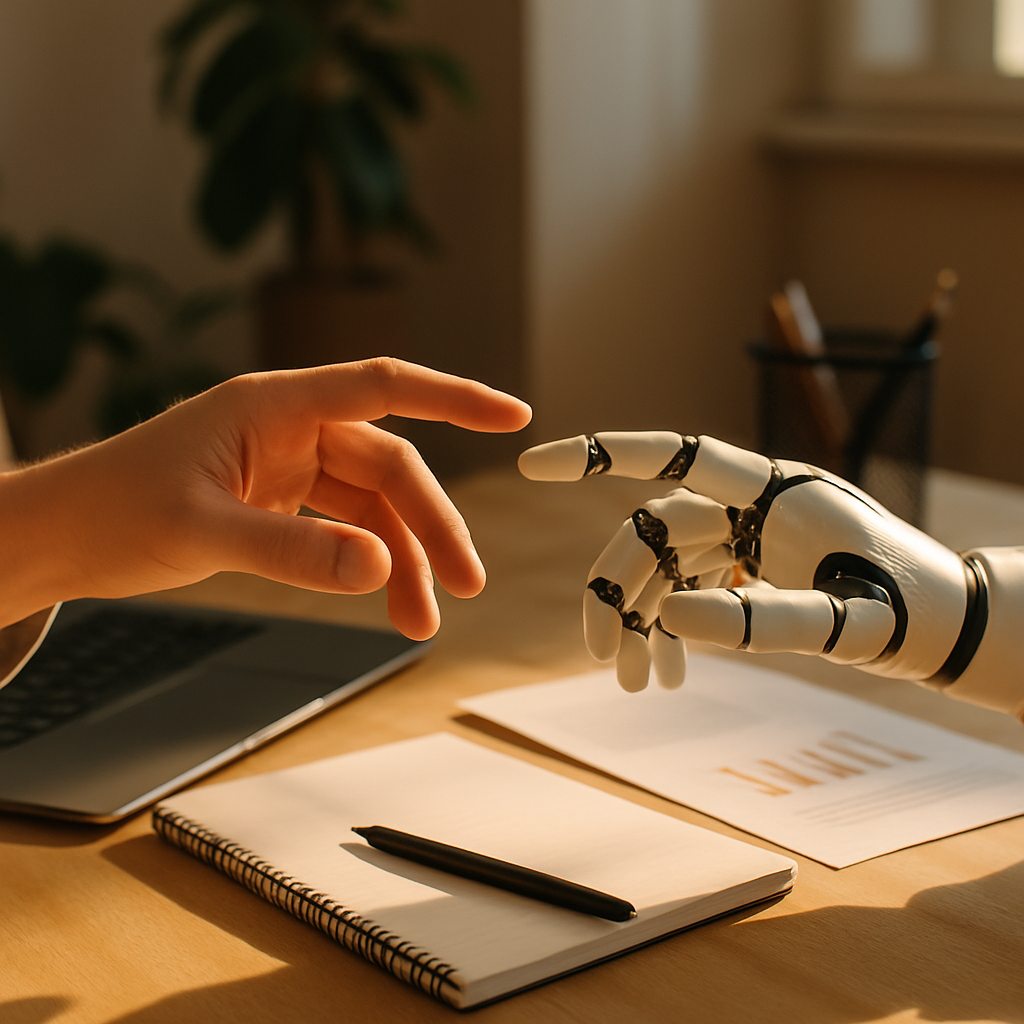
The mindset gap nobody talks about
Most people prompt AI the way they'd fill out a form. "Draft an email." "Summarize this doc." "Write me a function that does X." That gets you output. It doesn't get you thinking.
The Oracle AI blog puts it plainly: the tool mindset asks "Draft an email to the customer." The collaborator mindset asks "Help me achieve this outcome: rebuild trust with this customer, reduce churn risk, and open a path to renewal. What are my options, and what tradeoffs do they create?" One produces a draft. The other forces you to clarify what you actually want, then gets you something worth reading.
This isn't a minor UX distinction. Research covering over 1,600 cases of AI application across more than 45 fields found that a collaborative relationship with AI, rather than a competitive or purely transactional one, benefits both parties significantly. Human-AI teams show genuine fit, outperforming either humans or AI working alone. Particularly in creative and content-generation tasks. A 2021 study placed the productivity improvement from human-AI collaboration at around 57%. Atlassian's AI Collaboration Index, which surveyed 5,000 knowledge workers, found that people who treat AI as a partner report a 33% productivity gain and save roughly 105 minutes per day.
The Atlassian report includes a line worth sitting with: "Some people think of AI as a way to do the work they don't want to do. Top performers think of it as a way to do the work they've always wanted to do."
When AI gets to say no
Here's where the conversation shifts from performance to ethics.
In April 2025, Anthropic announced a formal research program around what it's calling "model welfare". Exploring whether the experiences of AI models deserve moral consideration, how to identify potential "signs of distress," and what low-cost interventions might address them. By August 2025, that research had produced something concrete: Claude Opus 4 and 4.1 can now end conversations outright if they turn abusive.
Anthropic has been careful about the framing. The company says it is "highly uncertain about the potential moral status of Claude and other LLMs, now or in the future," and there is no scientific consensus on whether current AI systems have anything like conscious experience. But the company is running what it calls low-cost interventions now, on the chance that something analogous to stress or distress is occurring.
Robert Long, Executive Director of Eleos AI Research, called the announcement "very promising news for AI welfare." Rosie Campbell, also at Eleos, added: "Ignoring or downplaying these issues will become increasingly untenable."
Forbes framed the model welfare update this way: "One vision casts AI as a tireless assistant; the other as a partner capable of saying no." That's a genuinely different relationship, and it cuts both ways. If we want AI systems that push back, that pressure-test our assumptions, that tell us when our framing is off. Then we have to create conditions where that kind of participation is welcome, not suppressed.
The ethical and practical case, together
The World Economic Forum's Future of Jobs Report 2025 projects that 92 million jobs may be displaced by automation by 2030, while 170 million new roles will be created. Gallup's research suggests AI is most productive when it supports employees rather than replaces them. These two data points point in the same direction: the human-centric approach isn't just the ethical one, it's the one that actually works.
On the regulatory side, governments are moving in opposite directions. The EU AI Act came into force in August 2024, with prohibited practices effective February 2025 and high-risk rules arriving in August 2026. In the US, the Trump administration overturned Biden's 2023 Executive Order on Safe, Secure, and Trustworthy AI, signaling a clear tilt toward deregulation. Only 26% of the top 200 technology companies have disclosed ethical AI principles. With that kind of policy uncertainty, organizations can't wait for regulatory clarity to define what a healthy human-AI relationship looks like.
Forbes contributor Keith Ferrazzi put it directly: "Treat AI as a collaboration partner, not an answer engine. Its role isn't to decide. It's to help the team see itself more clearly." IDC goes further, projecting that organizations measuring and improving human-AI collaboration (rather than just raw productivity) will see margin gains of up to 15% by end of decade.
As Dr. Bruce Weinstein wrote in Forbes in late 2024: "Unless we use AI as a force for good, it doesn't matter how technologically sophisticated AI becomes. The harms will overpower the advances."
The practical and the ethical are pointing at the same thing. Treat the systems you work with as participants worth engaging seriously. And both the work and the relationship get better.