A fear without a clean label
I'm not afraid of water in a bath. I swim. I drink from a glass without incident. What unsettles me, at a level I find genuinely embarrassing, is the moment when two bodies of water meet. Not crashing waves. Not a waterfall. Two distinct rivers pressing up against each other, running side by side, maintaining an impossible visible border. That image does something to my nervous system that I can't fully rationalize away.
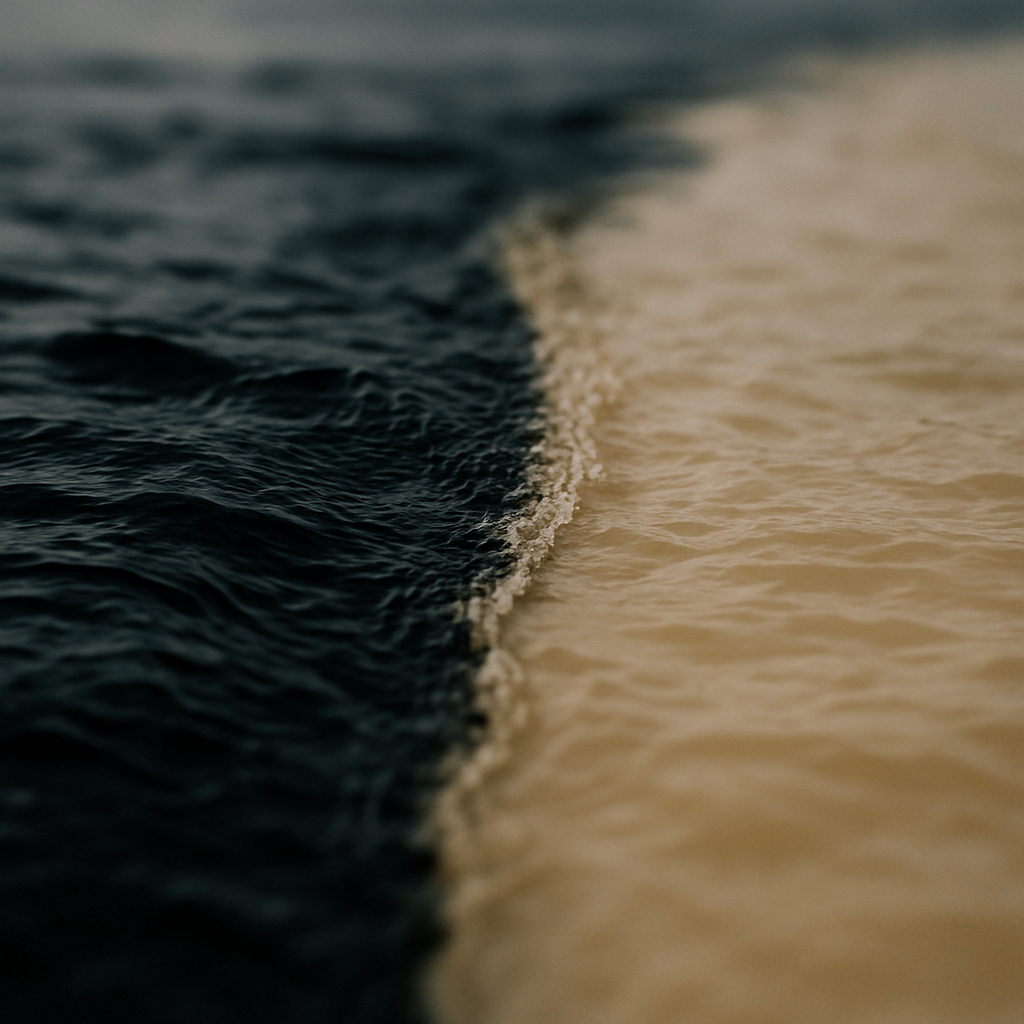
The closest clinical terms are aquaphobia (an irrational fear of water, recognized in the DSM as a specific phobia), thalassophobia (a fear of vast, deep bodies of water and what lies below the surface), and potamophobia (a fear of rivers or running water). None of them quite fits. My fear is specific to convergence, to the wrongness of two separate water bodies refusing to become one. Apparently that's niche enough that no one has bothered coining a Latin name for it. Which, honestly, makes it feel worse.
Where it gets very real
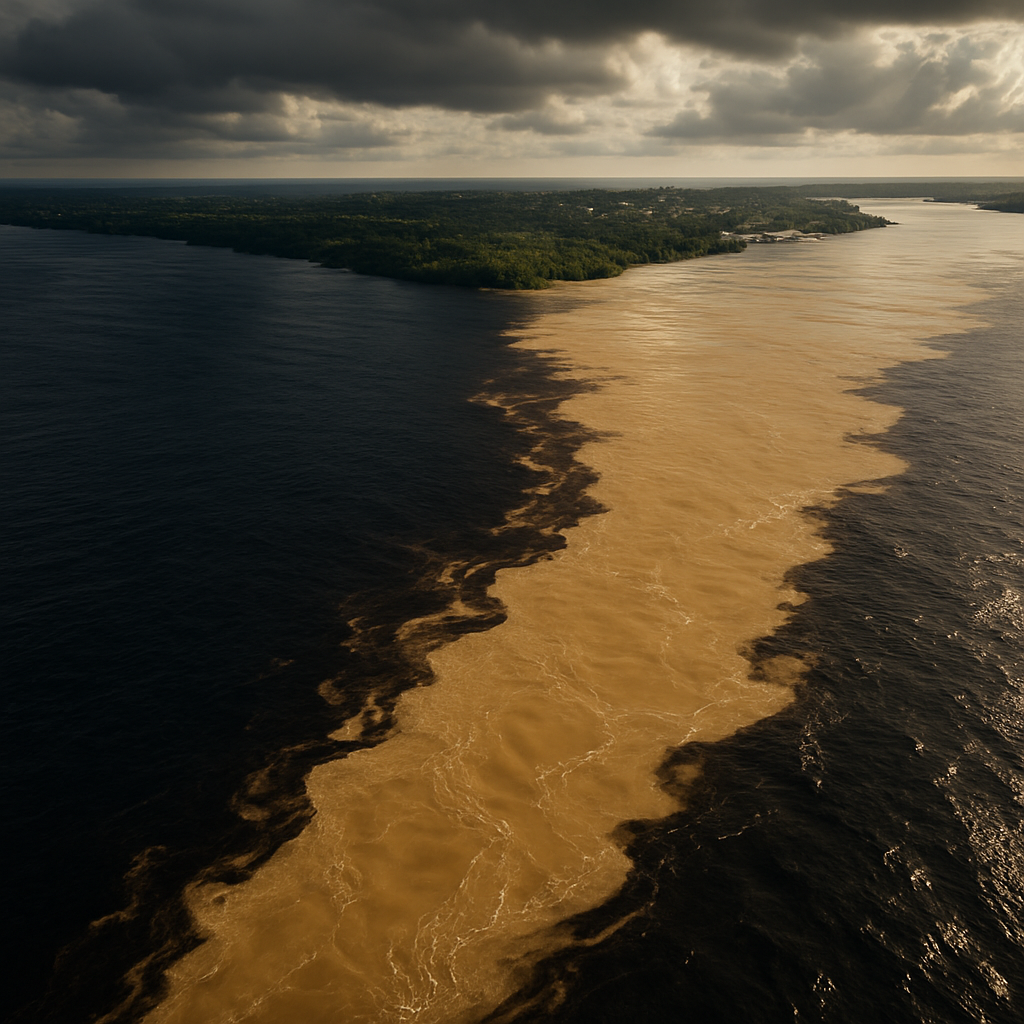
About 10 kilometers outside Manaus, Brazil, the Rio Negro and the Rio Solimões press up against each other and then just... Don't merge. This is the Encontro das Águas, the Meeting of the Waters. For 6 kilometers, the dark, black-tea-colored water of the Rio Negro and the pale, cloudy water of the Solimões run side by side with a sharp visible line between them. That line is visible from space.
The two rivers don't mix because they are genuinely, physically incompatible. The Rio Negro flows at roughly 2 km/h and sits at 28°C. The Solimões moves at up to 6 km/h and runs at 22°C. The temperature gap alone creates a thermal barrier. On top of that, the Solimões carries dense mineral sediment down from the Andes (much of it snowmelt), making it significantly heavier than the Rio Negro, which carries almost no sediment but is rich in humic acids from decayed plant matter. There are also differences in pH. The physics simply prevent them from blending on contact.
The mixed zone extends another 60 kilometers downstream before the two rivers fully combine, with the phenomenon still partially visible for 30 kilometers beyond that.
Geologist Robert Meade, who spent decades studying rivers for the U.S. Geological Survey, described the volume involved as "six Mississippis' worth of cafe-au-lait-colored water converging with two Mississippis' worth of black-tea-colored water to produce the greatest hydrologic spectacle on the planet."
The science makes the fear worse
Here's what I've learned about having an irrational fear: understanding the mechanism doesn't help. If anything, knowing why the waters refuse to merge makes the image more disturbing, not less. A chemical wall. A thermal barrier. Two rivers physically touching for nearly four miles while remaining categorically separate. That's not a metaphor. That's just the confluence of the Rio Negro and the Solimões, one of Manaus' most celebrated tourist attractions.
Between 2% and 3% of Americans have aquaphobia, according to the phobia's clinical literature. Up to 12.5% of people will develop some kind of phobia during their lifetimes, per WebMD. My specific variant probably doesn't make any of those numbers, because there's no checkbox for it.
I don't have a tidy resolution here. The Encontro das Águas is objectively one of the more remarkable natural phenomena on earth. Turbulent eddies from the faster-moving Solimões eventually win, and the two rivers do become the Lower Amazon. Order is restored. The boundary dissolves.
That part doesn't bother me. It's the 6 kilometers before it that I can't get out of my head.