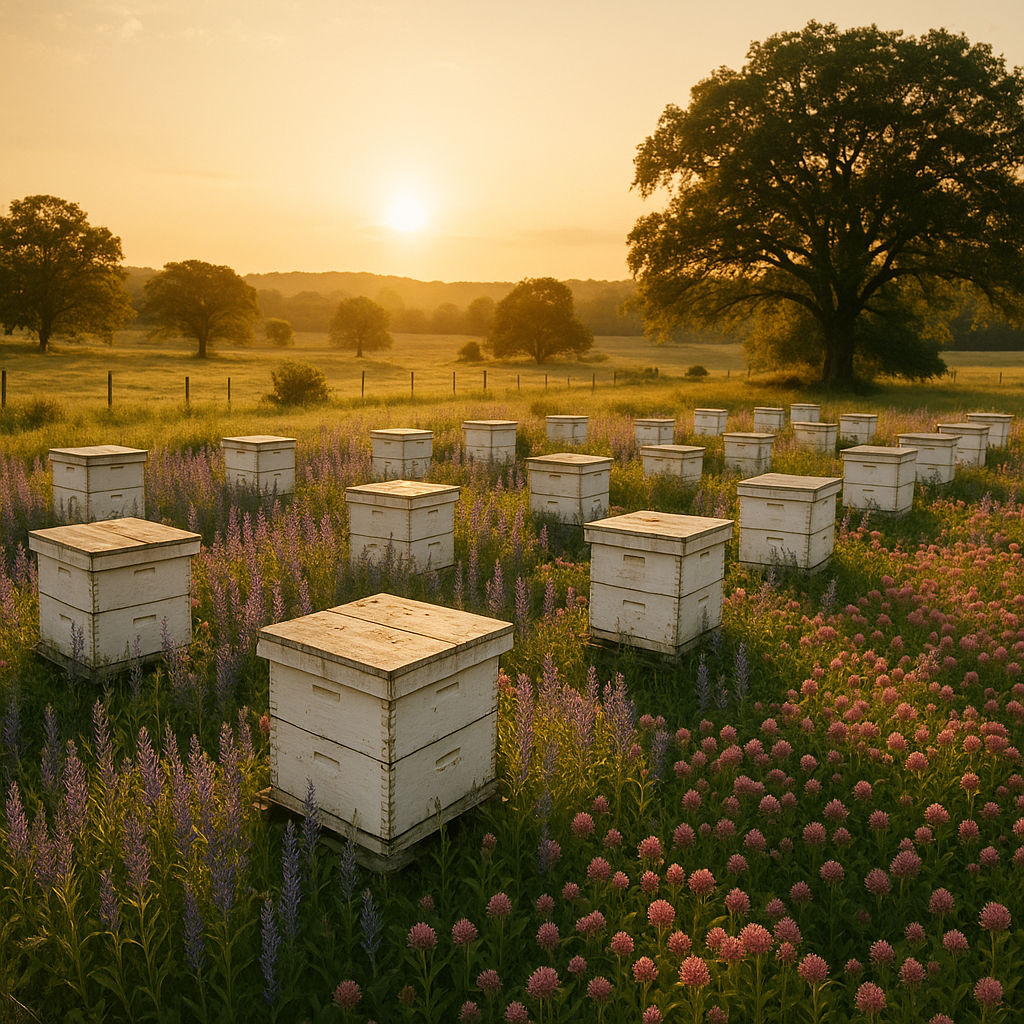
Most people know Morgan Freeman's voice before they know anything else about him. So when he showed up on The Tonight Show with Jimmy Fallon in 2014 and announced he had converted his 124-acre ranch in Charleston, Mississippi into a honeybee sanctuary, the internet paid attention.
He imported 26 hives from Arkansas to get started. The ranch gave the bees access to flowering plants and sugar water. Over time, he grew that to 40 hives, with room to expand further. He planted lavender, clover, and magnolia trees specifically to support the colonies.
What he did not do was harvest honey. He has not disrupted the hives. He does not wear a beekeeping suit or a bee hat. As he put it: "I have not ever used the beekeeping hat with my bees. They haven't stung me yet, as right now I am not trying to harvest honey or anything, but I just feed them. I also think that they understand, 'Hey, don't bother this guy, he's got sugar water here.'"
His approach is conservation-first, full stop. The hives exist to repopulate, not to produce.
Freeman did not pick beekeeping at random. He took it up in direct response to colony collapse disorder (CCD), a phenomenon first reported in 2006 in which the majority of worker bees in a hive suddenly disappear, leaving behind a queen, food, and nurse bees. The hive does not die dramatically. It just empties.
The numbers behind CCD are grim. A 2016 survey supported by the USDA found that beekeepers lost nearly half their colonies between April 2015 and April 2016. More recently, the Bee Informed Partnership reported that beekeepers lost 50 percent of their colonies in the single year from April 2022 to April 2023. A University of Vermont study found that wild bee populations in the United States declined by 23 percent between 2008 and 2013.
The economic exposure is real. According to data from the USDA's Invasive Species Information Center, pollinators contribute more than $24 billion to the U.S. Economy annually. Honeybees alone account for $15 billion of that. One-third of the American diet comes from insect-pollinated plants, and honeybees are responsible for 80 percent of that pollination.
Freeman's framing of this in a 2016 interview on Larry King Live was direct: "There has been a frightening loss in bee colonies, practically in this country. To such an extent that scientists are now saying, 'this is dangerous.'"
The detail that separates Freeman's approach from hobbyist beekeeping is the refusal to harvest. Most backyard beekeepers suit up, pull frames, and spin honey. Freeman runs what amounts to a repopulation operation. The bees live undisturbed. The goal is not yield; it is survival.
On The Tonight Show, he connected the stakes to the broader food system: "There's a concerted effort to bring bees back onto the planet. We do not realize that they are the foundation, I think, of the growth of the planet, the vegetation."
That framing is not hyperbole. Honeybee pollination underpins a significant portion of the fruit, nut, and vegetable production that Americans eat. When colony counts drop by half in a single year, that is not an abstract ecological concern. It is a supply-chain problem with a slow fuse.
Freeman's bees are not solving CCD on their own. Forty hives on 124 acres in Mississippi is a small number against a national crisis. But the sanctuary model, planting pollinator-friendly species, avoiding pesticide pressure, and leaving hives alone to operate naturally, is the kind of low-intervention approach that conservation researchers generally support.
The bee sanctuary sits inside a longer pattern of environmental engagement. In 2014, Freeman worked with filmmaker Louie Schwartzberg on a short documentary called What's Possible, presented at the United Nations Climate Summit to illustrate how global warming affects ecosystems and communities. Climate change and disaster relief have been consistent priorities for him over the years.
Bees became a personal focus, something he tends to directly rather than funds from a distance. There is a difference between writing a check and importing 26 hives, planting clover, and spending time around the colonies without protective gear.
One caveat worth stating plainly: all verified reporting on Freeman's sanctuary traces back to statements he made in 2014. Snopes noted in 2021 that they could not confirm whether he was still actively keeping bees at that point. The story has continued to circulate in 2026, but no post-2021 primary source confirms the current status of the operation. What is documented and confirmed is what he built and why.
You do not need 124 acres. The mechanics of what Freeman did at scale translate directly to a backyard or a community garden plot.
Plant lavender, clover, or native flowering species. Reduce or eliminate pesticide use in whatever space you control. If you do keep hives, consider whether harvesting is the point or whether giving the colony room to grow is the better outcome. The bees will tell you something either way.
The colony collapse numbers are not improving on their own. Individual action does not reverse a structural problem, but it does add up, and public figures putting their land behind the issue rather than just their words tends to move conversations in a way that position papers do not.
Freeman understood something practical: if honeybees disappear, a substantial portion of the food system goes with them. His response was to plant magnolia trees and import some hives. That is a reasonable place to start.