Andrej Karpathy coined “vibe coding” in February 2025, and the description was unusually honest about what it meant. He was building a webapp called MenuGen, talking to Cursor Composer through a voice interface, clicking “Accept All” on every suggestion, and barely touching his keyboard. His words: “fully give in to the vibes, embrace exponentials, and forget that the code even exists.” He was explicit that this was a posture for throwaway weekend projects.
That context got lost almost immediately.
What vibe coding actually means
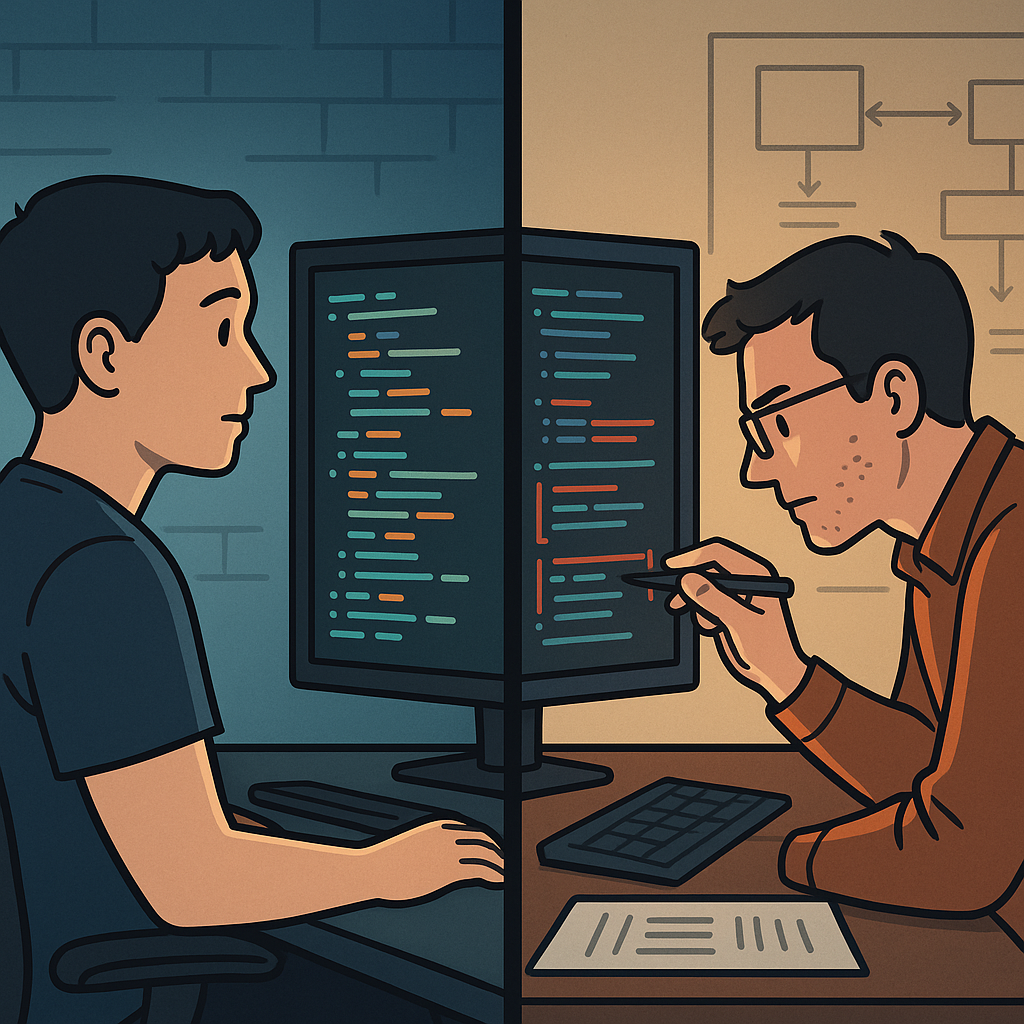
Vibe coding is a practice where you describe what you want in a prompt, the LLM generates the code, and you accept it without thoroughly reviewing or understanding it. As Merriam-Webster put it when they listed the term as a slang expression in March 2025, the coder “does not need to understand how or why the code works” and accepts that some bugs and glitches will be present. You are operating at the workflow level, describing services, UI scaffolds, and data models in plain language and letting the agent figure out the implementation.
The goal is speed. Think permanent hackathon mode: iterate fast, get something running, move on. For a proof-of-concept or a personal side project, that trade-off can make sense.
What AI-assisted development actually means
AI-assisted development is different in one specific way: you stay in control of the decisions. The AI suggests code, generates boilerplate, catches bugs, and handles documentation. You review its output, test it, and make sure you can explain how it works. Programmer Simon Willison drew this line cleanly: if an LLM wrote the code and you then reviewed it, tested it, and could explain it to someone else, that is not vibe coding.
Architecture, security, and business logic remain your responsibility. The AI accelerates execution; it does not replace engineering judgment. According to SonarSource, effective AI-assisted development requires human oversight and automated verification to ensure AI contributions meet the same standards as manually written code.
The tool does not decide which one you are doing
Cursor, Windsurf, and Claude Code appear on both lists, and that is not an accident. As the team at madewithlove noted, if you hand over complete control, accept every suggestion, and let the agent push the commits, you are vibe coding regardless of the tool. The posture determines the category, not the software.
Where the risks show up
The data on unreviewed AI-generated code is not encouraging. A December 2025 analysis by CodeRabbit of 470 open-source GitHub pull requests found that AI co-authored code contained approximately 1.7 times more “major” issues compared to human-written code. In May 2025, the vibe coding app Lovable made headlines when 170 out of 1,645 applications it generated had a vulnerability that exposed personal information. A Veracode study from October 2025 found that while LLMs had gotten much better at generating functional code over three years, the security of that code had not improved, and larger models were no better than smaller ones at getting it right.
Simon Willison put it directly in a piece covered by Ars Technica: “Vibe coding your way to a production codebase is clearly risky. Most of the work we do as software engineers involves evolving existing systems, where the quality and understandability of the underlying code is important.”
Choosing the right posture
Vibe coding is a legitimate tool for prototypes and personal projects where the cost of a bug is low and the code is not going to be maintained. AI-assisted development is the appropriate posture for anything that ships to users, requires ongoing maintenance, or touches sensitive data. As ellow.io put it, for long-term systems the difference between the two determines whether your product becomes sound engineering or accumulated technical debt.
Andrew Ng said at the LangChain Interrupt conference that the name itself causes confusion: “It’s misleading a lot of people into thinking, just go with the vibes.” He called coding with AI “a deeply intellectual exercise,” and added that after a full day of it, he is “frankly exhausted.” That aligns with Google Cloud’s 2025 DORA research, which found that 90% of software development professionals now use AI, spending a median of 2 hours a day on it in their core workflows. The productivity gains are undeniable. So is the cognitive load when you are doing it properly.